Before the Printed Hymnbook: Songs Passed by Voice
See how songs passed by voice through repetition, memory, and local variation, and learn how a community can keep shared singing legible to newcomers.
A song passed by voice can travel farther than its first singer, though it may not arrive unchanged. Before a printed hymnbook offered a shared page, people learned hymns and other communal songs by hearing them, joining in, and carrying remembered versions into another room or gathering.
That journey depended on more than a strong memory. Repetition made a tune familiar, local choices made it usable, and each new singer decided—often without noticing—what to keep or alter. Consider how those forces might work in one invented village, where a song must make its way across generations without a book to settle its form.
A song begins in a room, not on a page
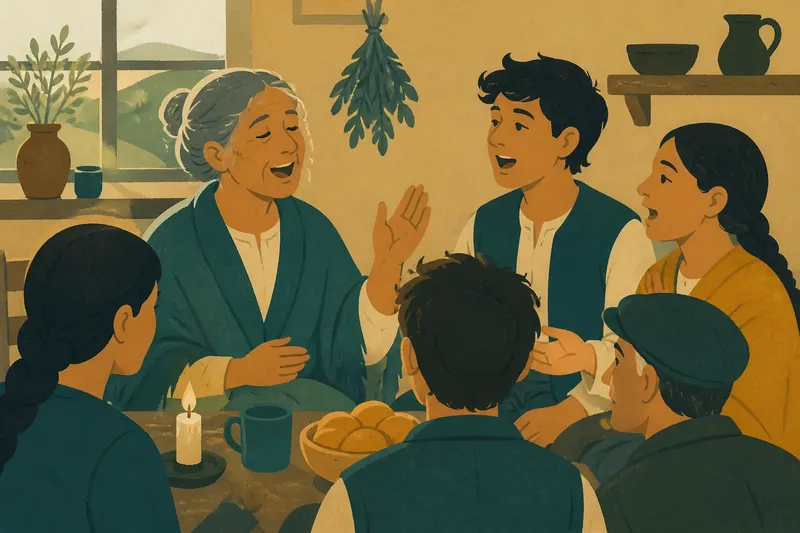
Imagine a small farming village where people gather for a seasonal meal. An older resident, Mara, knows a simple hymn from years of hearing it at home and in community worship. She starts it without a written copy, and a few neighbors join once they recognize the tune.
The first gathering does not need to produce a polished performance. Some listeners may know only the opening phrase; others may supply words from memory or wait until a line returns. Mara sings at a pace that leaves room for the group, and the returning melody gives uncertain singers another chance to enter.
Afterward, a young neighbor, Ellis, remembers enough to sing it to a cousin. The cousin picks up the tune before learning every word. The song has already moved beyond Mara, but what travels is a partial, practical version: a melody, a familiar refrain, and a sense of when the group responds.
In this imagined starting point, the song survives because someone can begin it and others can recognize where to join.
Repetition gives memory a place to land
At the next gathering, Mara sings the hymn again. Ellis now knows more of it, and the cousin catches the refrain. Repeating the song in the same social setting helps listeners connect its sound to a sequence: an opening, a return, and an ending the group can anticipate.
Repetition also distributes the work of remembering. One person may recall the first line while another holds the refrain; a confident singer can quietly lead while less certain voices follow. The group does not have to depend on any single person retaining every word and note.
That shared memory can be strengthened by ordinary occasions rather than formal lessons. A song heard at a meal, a gathering, or a seasonal observance gains a familiar place in people’s lives. The event supplies a cue: people know which song belongs there, even if they cannot explain when they first learned it.
For a community trying to pass on a song, return to it naturally instead of treating each appearance as a performance test.
Local variation helps the song fit its singers
Now imagine Ellis sings the hymn at a gathering in a neighboring hamlet. The people there know a related version, but their usual lead singer begins it at a different pitch, and the group favors a slightly different word in one line. Ellis listens, joins their version, and later brings parts of it home.
Those changes need not signal carelessness. A tune may settle into a pitch range that suits the voices present; words may shift through accent, remembered phrasing, or a local expression. Singers may lengthen a held note to let the group catch up, or make a small melodic turn that feels natural in their community.
In the invented village, the next gathering includes both the old and new details. Mara keeps the familiar opening, while Ellis offers the neighboring hamlet’s version of the refrain. The group accepts the blend because it remains recognizable and supports their way of singing together.
Oral tradition is not simply a chain in which each singer copies an exact original. It is a living exchange: listeners retain what makes sense to them, adjust what they need, and pass on a version the next group can use. The song’s identity may rest less on identical notes than on shared recognition and purpose.
Memory has limits, and communities answer them together
Suppose Mara is absent at a later seasonal gathering. Ellis can begin the hymn, but a verse slips away. Another neighbor remembers the missing words, while someone else recalls the closing phrase. Their combined recollections let the group continue without pretending that every detail is certain.
That moment shows both the strength and fragility of oral transmission. Shared singing can preserve a song across changing households and generations, yet a rarely sung verse may fade, and a melody can drift when only a few people carry it. A community may respond by singing the song more often, inviting younger members to lead, or asking several people to teach it rather than relying on one keeper.
In this imagined case, the neighbors decide to sing the hymn at another gathering and ask a younger singer to start it. They do not demand that the new leader imitate Mara precisely. Instead, the group helps with the refrain and gently corrects uncertain words, making participation part of learning.
When a song feels at risk of being forgotten, make room for more people to lead it.
What can a community preserve without fixing every note?
As the village’s song travels, people begin to notice that it has more than one form. Some value the version Mara first sang; others feel attached to the neighbor’s refrain. The group can respect both memories without declaring one the only legitimate version.
If singers want a record, they might write down a remembered text or make an audio recording, with permission from the people involved. Such a record can help later singers compare versions, but it cannot replace the relationships that taught the song: who starts, how others join, and what the gathering means to those present.
Imagine the village keeps a short note naming the two versions and the occasions where each is sung. At the next gathering, a newcomer hears both and learns that variation is part of the song’s local history, not a mistake to erase. The useful result is not a final, frozen form; it is a clearer path for the next singer to learn what the gathering means to those present.
When a printed hymnbook eventually appears, it can offer another reference point. It may preserve one arrangement or set of words, but the village’s sung practice can still carry accents, choices, and memories that do not fit neatly on a page. The book records a version; the singers keep making the tradition audible.
How do oral songs travel between generations?
How does repetition help people learn a song?
Repeated singing lets people connect words and melody with familiar cues, such as a refrain or a regular gathering. It also gives different singers chances to contribute the parts they remember.
Why do local versions of a hymn differ?
Communities adapt songs to their voices, accents, habits, and remembered wording. A changed note or phrase can reflect ordinary transmission rather than a deliberate attempt to replace an earlier version.
What can a group do when a song is fading from memory?
Bring it back into gatherings, invite more than one person to lead, and let newer singers learn by joining in. If people want a written or recorded aid, they can make one while recognizing that it captures only part of the tradition.
Does a printed version end oral variation?
No. A printed page may help stabilize one arrangement, but singers can continue to carry local wording, pitch choices, and performance habits. The version on paper and the version heard in a room can remain related without being identical.
The invented village’s hymn reaches younger singers not because every note stays fixed, but because people return to it, listen to one another, and make room for newcomers. To understand a song passed by voice, pay attention not only to what the group sings, but to who teaches the next person where to begin.